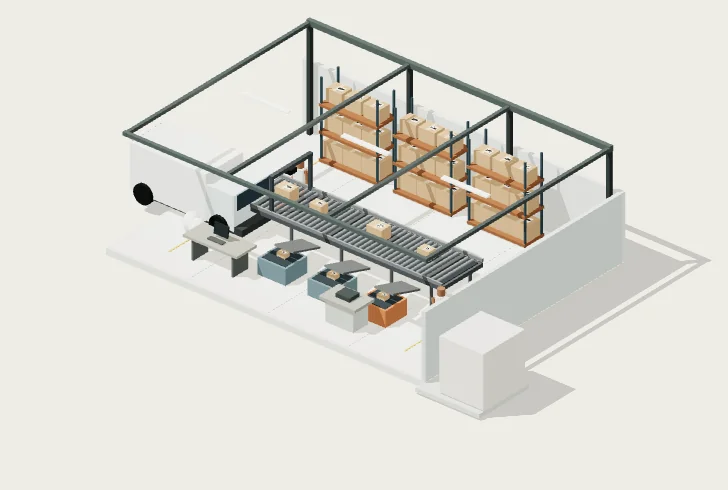
Katta at the door
White bags arrive through one receiving door. Each katta carries its own bag barcode.
THE RECORD
Bag DLV-…-07 received · manifest match

Sorting automation
Delv's sorting line moves a parcel from the inbound katta to its destination bin. Scanning and exception handling run today; the conveyor and automatic diverter are planned.
Inside the hub
Choose a step, or scroll — the model follows the parcel through the same six steps the floor runs today.
White bags arrive through one receiving door. Each katta carries its own bag barcode.
Bag DLV-…-07 received · manifest match
The bag is opened and scanned, then every piece inside is scanned to its shipment record.
38/38 pieces scanned to record
Pieces travel on a belt past a fixed scanner, instead of being carried by hand.
Belt scan · piece read in motion
A diverter reads each barcode in motion and pushes the piece to its route bin.
Diverter match · route bin assigned
A piece that doesn’t match goes to a separate bin, with one named person responsible for it.
Unmatched · owner assigned · reason required
The route bin becomes the rider’s tray. An out-scan records exactly what left the hub.
Out-scan · rider R-021 · 46 pcs
What changes
Fewer repeated touches and less manual destination sorting. Receiving, feeding, exception and handover roles stay — a complete operation still needs people.
Labour effort per parcel and elapsed time to dispatch are measured separately. A faster belt alone doesn't fix a waiting queue or an incomplete manifest.
Labour is compared against the full cost of the line: equipment, maintenance, energy and the work it still needs around it.
Interactive operating model
Same daily volume and shift hours, compared manual handling against an assisted line.
Monthly net saving
After equipment, maintenance and additional power.
6,000 parcels/day · 8-hour shift
Person-hours = daily volume divided by parcels per person-hour. People per shift = person-hours divided by productive shift hours, rounded up. Monthly labour = people times loaded person-day cost times operating days. Assisted cost adds equipment, maintenance and extra power. Net saving = manual labour minus assisted total cost.
Use a monthly equipment cost, including depreciation and financing as appropriate. Both rate inputs must cover the same end-to-end handling scope. Productive hours exclude breaks and downtime. Floor rent, tax and exception costs are excluded unless you include them yourself. No reduction in failed deliveries or sorting errors is assumed.
Start here
Include volumes, staffing, productive hours, costs, parcel dimensions and dispatch windows.